What Is the Role of a Financial Calculator Online in Business Decisions?
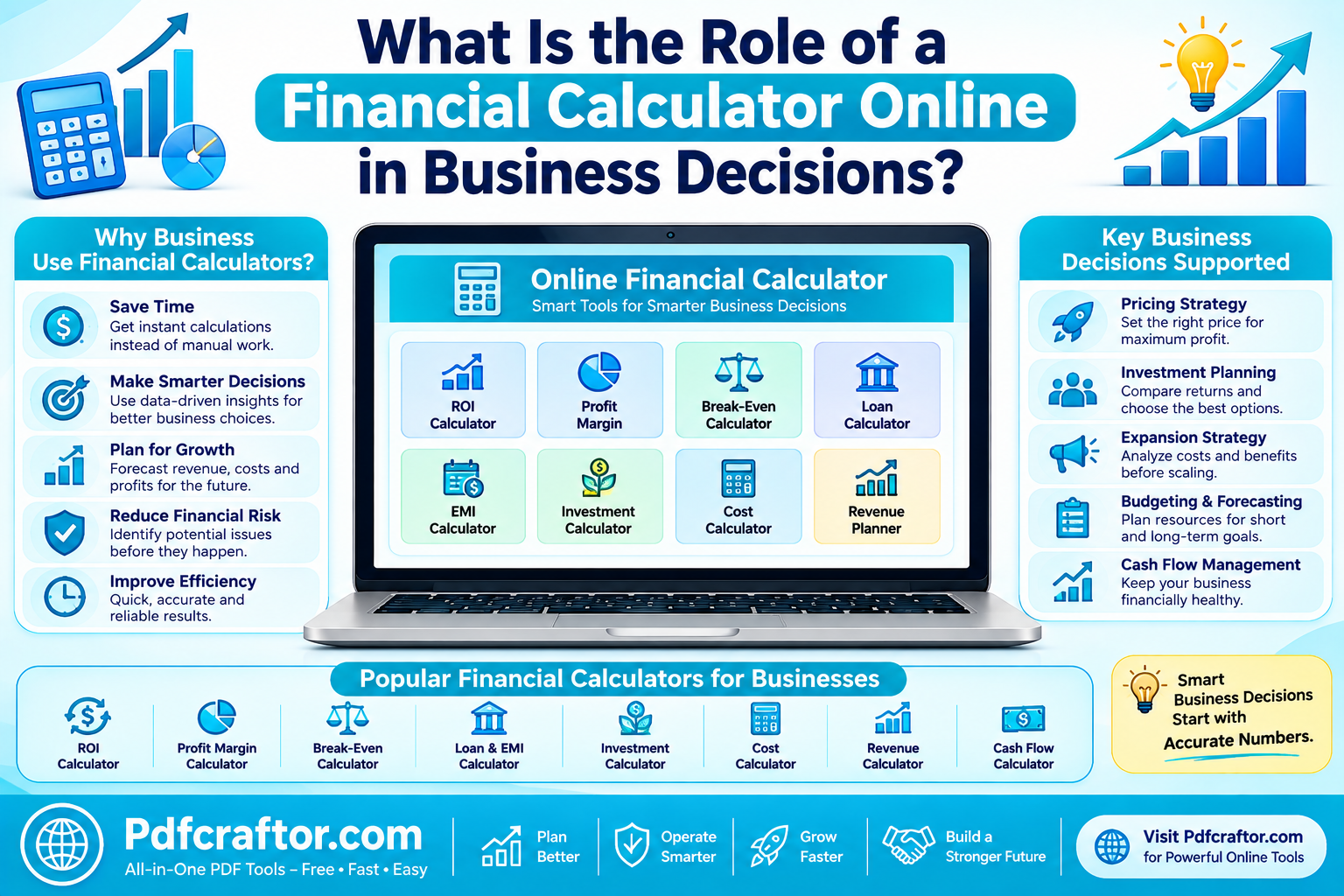
A financial calculator online replaces gut feel with exact numbers at four key business moments: pricing a product (margin calculator), taking a loan (EMI calculator), billing taxes correctly (GST calculator), and parking surplus cash (NSC or FD calculator). Each check takes under a minute and costs nothing, which is why small businesses use them daily.
- Price it: margin calculator shows real profit, not hopeful profit
- Borrow it: EMI calculator tests the loan against monthly cash flow
- Park it: NSC calculator shows guaranteed growth on idle funds (currently 7.7%)
Every small business owner makes financial decisions daily. Very few make them with actual calculations.
Ask a shop owner what margin they earn on their best-selling product, and you'll often get a confident wrong answer, because margin and markup got mixed up somewhere. Ask whether the new loan EMI fits the monthly cash flow, and the answer is frequently "it should be fine". These aren't carelessness, they're time problems. Sitting with spreadsheets is nobody's idea of running a business. Free online calculators fix exactly this: thirty-second answers, zero cost, no Excel formulas to remember. Here's where they change real decisions.
What Is an Online Financial Calculator?
A browser-based tool that takes two or three inputs and instantly applies a standard financial formula: EMI, compound interest, margin percentage, GST amount, maturity value. No installation, no signup, no accounting knowledge needed.
The value isn't the formula, any accountant knows those. The value is speed at the moment of decision. When a supplier is on the phone asking you to confirm a price, or a bank manager slides a loan offer across the table, you don't have time to build a spreadsheet. You do have time to type three numbers into your phone. That's the entire role of these tools: making the correct calculation as fast as the guess.
Which Business Decisions Do Calculators Actually Improve?
Map your decision cycle to the right tool and the whole thing becomes routine:
| Business decision | Calculator to use | What it answers |
|---|---|---|
| Setting a selling price | Margin calculator | What do I really earn per unit? |
| Taking a business loan | Business loan EMI calculator | Does the EMI fit my monthly cash flow? |
| Billing and quoting | GST calculator | What's the tax-inclusive or exclusive price? |
| Parking surplus funds | NSC / FD calculator | What will idle cash grow into, guaranteed? |
| Comparing growth options | Compound interest calculator | What does this return compound to over years? |
Let's walk through the big four, with real numbers.
How Does a GST Calculator Keep Your Pricing and Billing Clean?
GST errors cut both ways. Quote a price forgetting to add GST, and the tax comes out of your pocket. Add GST on top of an already tax-inclusive purchase price while reselling, and your quote looks expensive against competitors.
A GST calculator handles both directions instantly: enter an amount and a rate, and it shows the tax-inclusive total, or works backwards from an inclusive price to reveal the base amount and tax portion. That reverse calculation is the one people get wrong by hand, and the one that matters most when a customer asks "what's the price without GST?"
For a business quoting ten jobs a week, this isn't a convenience. It's the difference between margins you planned and margins you discovered later.
Should You Take That Business Loan? Ask the EMI Calculator First
Business loans in India price higher than home or education loans, often 11 to 16%, because most are unsecured. That makes the EMI check non-negotiable before signing.
Say you're considering ₹10 lakh at 12% for new equipment. The business loan EMI calculator gives you the trade-off in seconds: a 3-year tenure means an EMI of about ₹33,214 with total interest near ₹1.96 lakh. Stretch to 5 years and the EMI drops to ₹22,244, but total interest climbs past ₹3.34 lakh.
Now the decision has shape. Can your monthly cash flow absorb ₹33,000 comfortably? Take the shorter tenure and save ₹1.4 lakh. Is cash flow tight in the off-season? The longer tenure buys safety, at a known price. Either answer can be right. What's never right is signing without knowing both numbers, and here's the part worth repeating: the equipment must earn more per month than the EMI costs, otherwise the loan is funding a hobby, not growth.
What's the Difference Between Margin and Markup When Pricing?
This mix-up quietly eats profits across lakhs of small businesses. If a product costs ₹800 and sells for ₹1,000, the markup is 25% (profit over cost), but the margin is only 20% (profit over selling price). A shop owner who wants a "30% margin" and adds 30% to cost actually earns about 23% margin. Multiply that 7-point gap across a year of sales, and it's real money that vanished into a definition.
A margin calculator ends the confusion: enter cost and selling price, see both figures correctly. It's especially worth rechecking prices after costs rise, a new loan EMI, costlier raw material, higher transport, because yesterday's healthy margin may already be gone while the price tag stays the same.
Where Should Idle Business Cash Sit? The NSC Calculator Answer
Seasonal businesses know the pattern: flush months, then lean ones. Surplus cash sitting in a current account earns nothing at all, and inflation quietly shrinks it.
For money you won't need for a few years, National Savings Certificate is a serious option: currently 7.7% per year, compounded annually, fully government-backed, with a 5-year term. The NSC calculator makes the outcome concrete: park ₹5 lakh today and it matures at roughly ₹7.24 lakh, a guaranteed gain of ₹2.24 lakh for doing nothing riskier than lending to the government. For proprietors, the investment can also qualify for a Section 80C deduction.
Shorter horizon? Run the same amount through the FD calculator and compare; FDs offer flexible tenures and easier exit. If you're weighing NSC against other post office schemes, our NSC vs KVP vs PPF comparison breaks down which suits which goal. The habit that matters: never let surplus cash sit unplanned. Calculate what it could earn, then decide deliberately, even if the decision is "keep it liquid".
Are Online Financial Calculators Accurate?
For the formula, yes, completely. EMI, compound interest, GST and margin calculations are standard mathematics; a good online calculator applies the same formulas your bank and CA use.
The honest caveat is the inputs. A loan calculator can't know about processing fees, insurance add-ons, or a floating rate revision next year. An NSC calculation assumes the current quarterly rate, which government revises. So treat calculator outputs as exact answers to "what do these numbers produce", and confirm final terms in the sanction letter or scheme document before committing. The calculator's job is to get you to that table informed; that job it does perfectly.
FAQ
How do financial calculators help in business decision-making?
They give exact numbers at the moment of decision: real margin on a price, actual EMI against cash flow, correct GST on a quote, and guaranteed maturity on parked funds. That replaces estimates with facts across daily pricing, borrowing and investment choices.
Which calculators should a small business use most?
Four cover most needs: a GST calculator for billing, a margin calculator for pricing, a business loan EMI calculator before borrowing, and an NSC or FD calculator for surplus funds. All are free online tools.
Can an NSC calculator help a business park surplus funds?
Yes. It shows the exact maturity value of any amount at the current 7.7% rate over 5 years. For example, ₹5 lakh grows to about ₹7.24 lakh, fully government-backed, which helps compare NSC against FDs or simply holding cash.
What is the difference between margin and markup?
Markup is profit as a percentage of cost; margin is profit as a percentage of selling price. On a ₹800 cost sold at ₹1,000, markup is 25% but margin is 20%. Confusing the two leads to underpricing.
Are online financial calculators accurate?
The mathematics is exact. Just remember they compute from your inputs, so factor in processing fees, floating rates or scheme rate revisions separately, and confirm final terms with your lender or the official scheme document.
Do I need to pay or sign up to use a financial calculator online?
No. Tools like PDFCraftor's calculator suite are free and need no account. Open the calculator, enter your numbers, and read the result, on desktop or phone.
Conclusion
The role of an online financial calculator in business is simple to state: it makes the correct number as easy to get as the guess. Price with the margin calculator so profit is planned, not discovered. Test every loan offer in the EMI calculator before the meeting, not after. Quote with GST computed, not assumed. And when the busy season leaves cash idle, let the NSC calculator show what a guaranteed 7.7% turns it into before you default to doing nothing. None of these checks takes a minute, and together they compound into something bigger than any single decision: a business run on numbers. The full set of 40+ free tools lives at the financial calculator online hub, bookmark it next to your banking app.
Share this article
Sharad Mishra
Content Writer
Published on August 16, 2026
Related Articles

How Does an Education Loan EMI Calculator Help in Financial Planning?
How an education loan EMI calculator helps in financial planning: test tenure and rate scenarios, keep EMI within your salary, and time Section 80E tax savings.
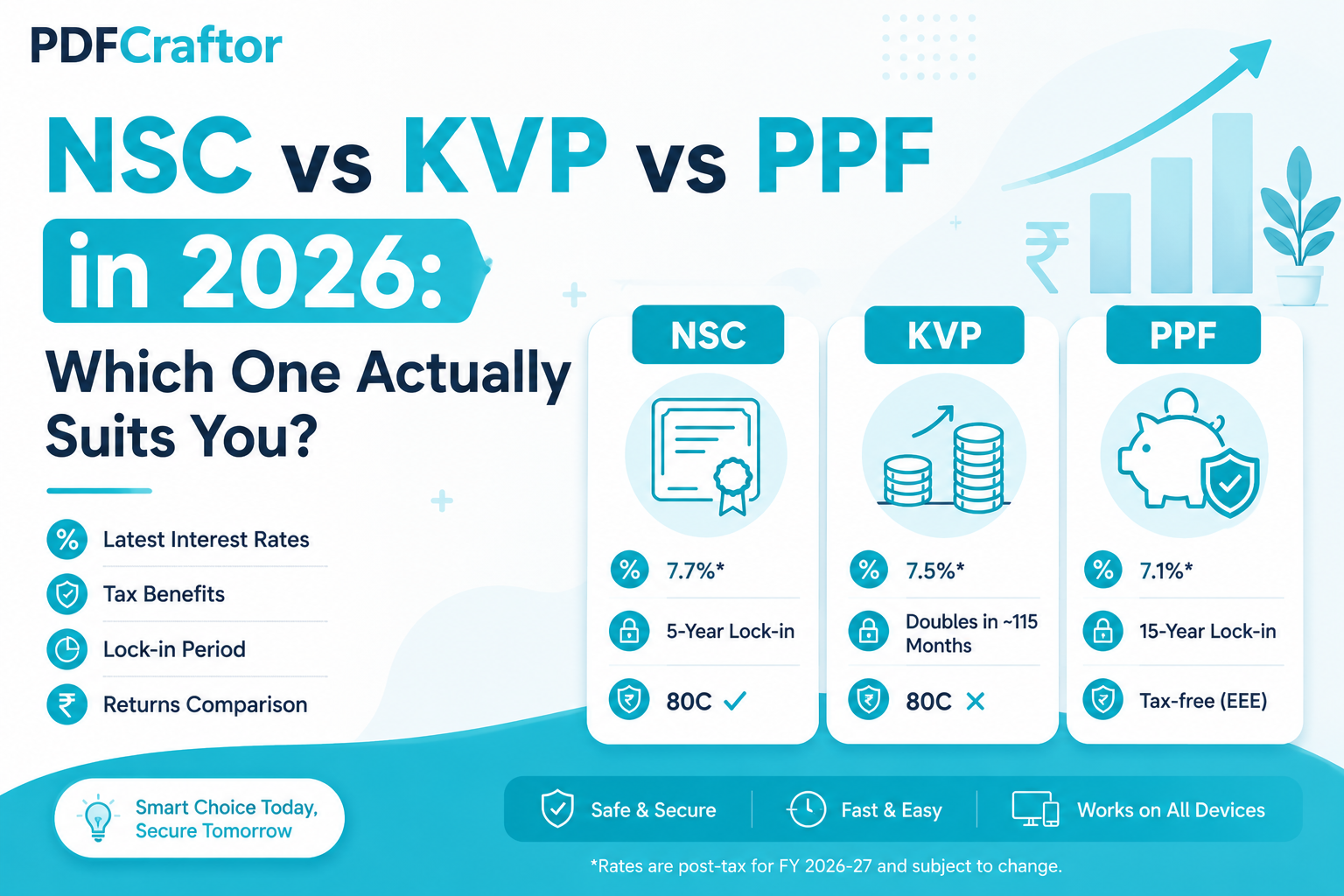
NSC vs KVP vs PPF in 2026: Which One Actually Suits You?
NSC vs KVP vs PPF compared for 2026, interest rates, lock-in & 80C tax benefits explained simply, so you can pick the right post office scheme for your goal.
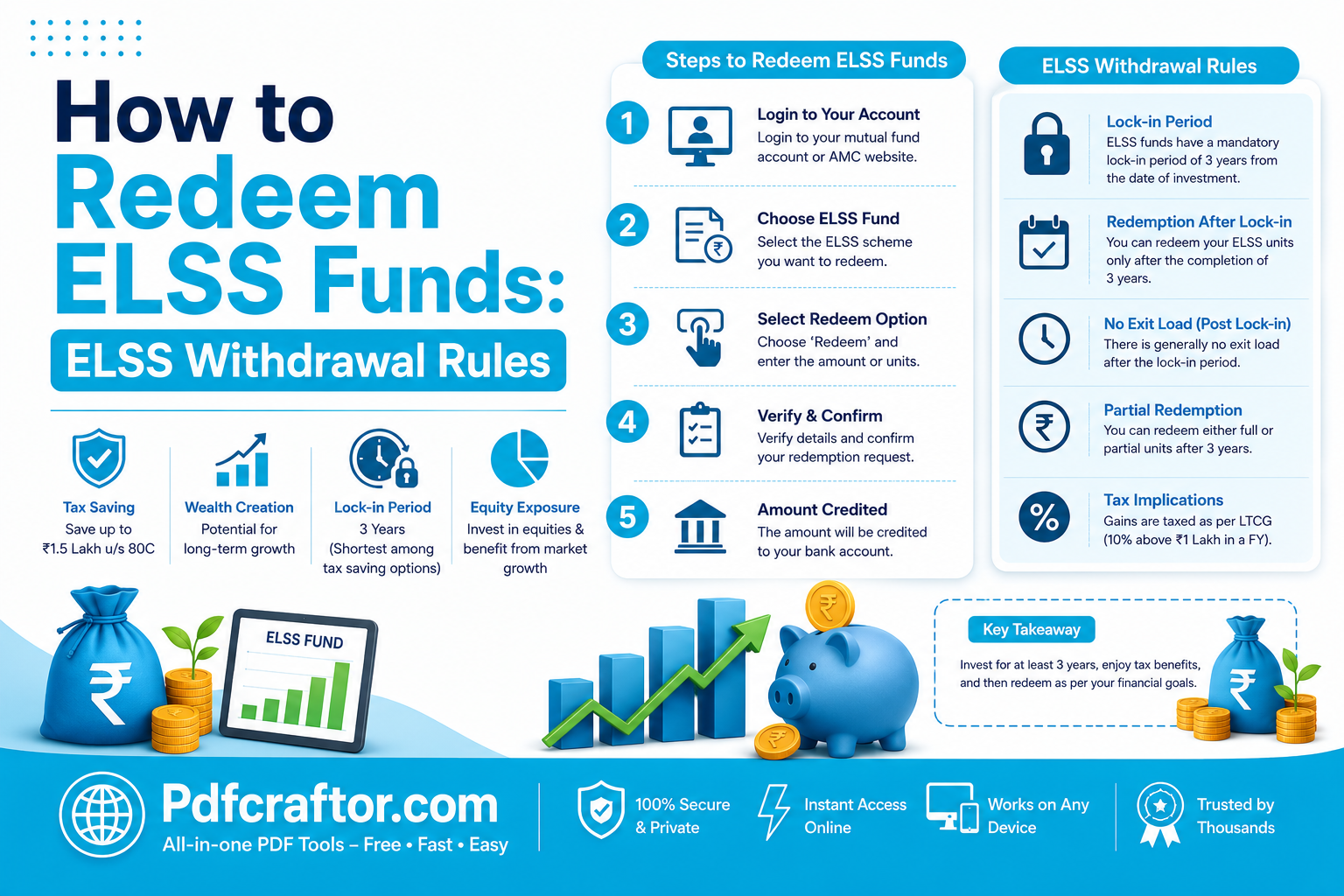
How to Redeem ELSS Funds: ELSS Withdrawal Rules
To redeem ELSS funds, first complete the mandatory 3-year lock-in — ELSS cannot be withdrawn early for any reason. After that, log in to your fun...